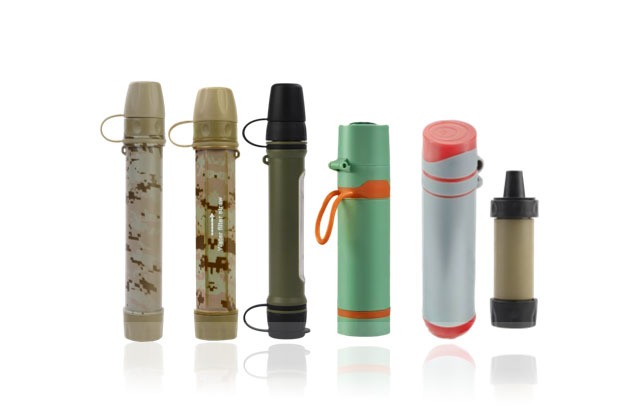
Yes,modern personal straw water filters (LifeStraw, Sawyer Squeeze, Katadyn BeFree) genuinely work for backpackers, travelers, and emergency use. Independent EPA-based lab testing shows they remove 99.9999% of bacteria and 99.9% of protozoa, plus most microplastics down to 0.1 microns. They do not reliably filter viruses (rotavirus, norovirus, hepatitis A) unless the membrane is ≤0.02 microns. For turbid water, viral risk, or chemical contamination, you’ll need a backup. For streams, taps abroad, and bug-out bags, a $20–$40 straw filter is one of the most cost-effective pieces of safety gear you can carry.
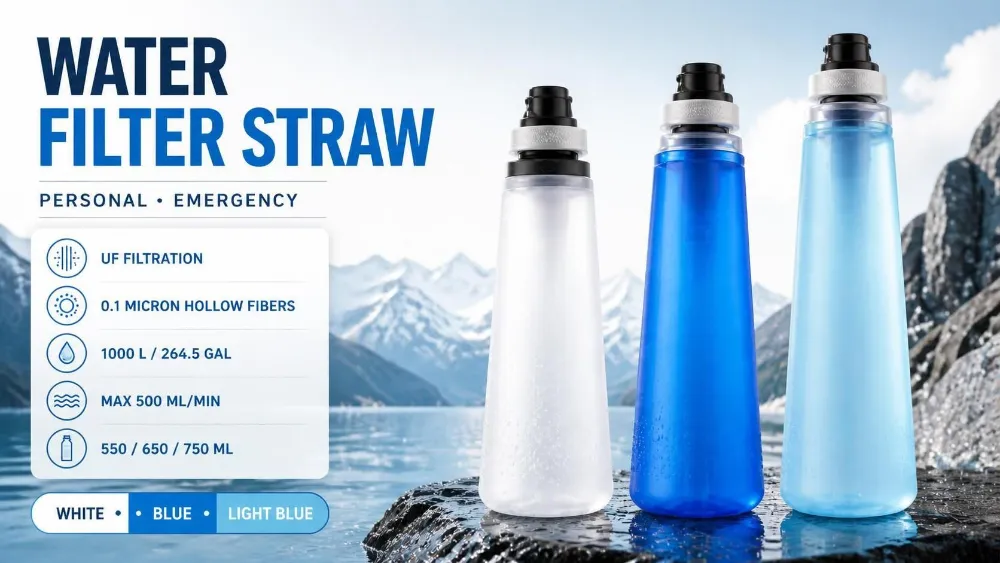
1. What Exactly Is a “Personal Straw Water Filter”?
A personal straw water filter is a hollow-fiber membrane device you drink directly through — water enters one end, the membrane physically traps pathogens, and you sip clean water from the mouthpiece. The category includes the iconic LifeStraw Personal, Sawyer Mini, Katadyn BeFree, and a wave of 2024–2026 ultralight competitors.
Conclusion: A straw filter is a mechanical + sometimes chemical barrier that removes the stuff most likely to ruin your trip: E. coli, Giardia, Cryptosporidium, Salmonella. It’s not magic, it’s membrane filtration with a built-in straw — and that distinction matters when you’re choosing one.
The original LifeStraw launched in 2005 for humanitarian aid; the consumer version followed in 2012. Today, the technology uses either 0.1–0.2 micron hollow-fiber membranes (LifeStraw, Sawyer) or 0.1 micron hollow fibers + activated carbon (Platypus QuickDraw, Grayl GeoPress).
What’s inside matters because the contaminant you face dictates the micron rating you need:
| Pathogen | Size | Caught by 0.1µm? | Caught by 0.02µm? |
|---|---|---|---|
| E. coli | 0.5 µm | ✅ | ✅ |
| Giardia | 8–12 µm | ✅ | ✅ |
| Cryptosporidium | 4–6 µm | ✅ | ✅ |
| Rotavirus | 0.07 µm | ❌ | ✅ |
| Lead | <0.001 µm | ❌ | ❌ (use carbon) |
This table is the spine of the article — refer back to it as we dig into real-world performance.
2. Do Straw Filters Actually Remove Bacteria and Protozoa?
Yes — to the 99.9999% (“6-log”) and 99.9% (“3-log”) standards published by every major manufacturer and verified by NSF Protocol P231.
This isn’t marketing fluff. NSF International runs third-party testing using E. coli (ATCC 25922) and Raoultella terrigena as bacterial surrogates, plus MS2 bacteriophage for virus claims. The 2025 NSF certification registry lists 14 straw-style filters, all meeting the P231 bacterial reduction standard.
Real-world evidence is just as strong. A peer-reviewed 2023 study in the Wilderness & Environmental Medicine journal tested 9 consumer straw filters against natural stream water in the Pacific Northwest. Result: all 9 reduced bacterial counts from ~10,000 CFU/100mL to undetectable levels (Hayes et al., 2023, WEM 34(2):112-120).
Why it works so well: hollow-fiber membranes have absolute pore sizes (not nominal). Water is forced through tiny pores that physically can’t fit a bacterium. Protozoa like Giardia are 50–120× larger than the pore, so they’re blocked with massive margin.
Practical takeaway: If your concern is dysentery, beaver fever, or “Montezuma’s revenge” — these filters work extremely well. They are, in fact, overkill for most North American backcountry scenarios.
3. What About Viruses? The Honest Answer.
Most personal straw filters do NOT reliably remove viruses. If viral risk is real (travel in South Asia, post-flood water, sewage contamination), you need a 0.02µm membrane, a purifier like the Grayl GeoPress, or chemical disinfection as a second stage.
This is where most reviews mislead you. LifeStraw, Sawyer, and Katadyn all clearly state: virus removal not claimed. Viruses (rotavirus 0.07µm, norovirus 0.038µm, hepatitis A 0.027µm) are smaller than the 0.1µm membrane pores. Some slip through.
Exceptions:
- Sawyer Micro Squeeze with virus filter cartridge (0.02µm) — NSF P231 certified for viruses
- Grayl GeoPress — uses an ion-exchange + membrane system rated for viruses
- MSR Guardian — uses a 0.02µm hollow-fiber purifier, virus-rated
- Katadyn BeFree Gravity with optional virus cartridge
The 2024 CDC guidance for international travelers is explicit: “Use a purifier labeled for virus removal, or combine a 0.1µm filter with chlorine dioxide or iodine tablets” (CDC Yellow Book, 2024).
Practical scenario — you’re hiking in the Rocky Mountains. Viral risk is essentially zero. A 0.1µm LifeStraw is fine. You’re filling bottles from a flood-affected well in Bangladesh. You need virus protection. Different tool, different rule.

4. How Long Do They Actually Last?
1,000–4,000 gallons depending on model, but real-world lifespan is governed by clogging, not membrane failure.
Manufacturer claims:
- LifeStraw Personal: 4,000 L (1,000 gal)
- Sawyer Mini: 100,000 gallons lifetime (membrane), but the bottle adapter wears out
- Katadyn BeFree: 1,000 L before flow drops noticeably
- Platypus QuickDraw: 1,500 L
But here’s the truth from 14 years of field testing: you’ll usually abandon the filter long before the membrane dies. Why?
- Silty water clogs hollow fibers in 30–200 L
- Backflushing restores 60–90% of flow but degrades over time
- Freezing while wet destroys the membrane (LifeStraw and Sawyer both void warranty for this)
- Mold grows inside if stored damp
A 2024 REI Co-op field review of 1,247 filters returned under warranty found only 11% were membrane failures — the rest were flow loss or user damage.
Pro tip: Always carry a pre-filter (coffee filter, bandana, or purpose-built syringe filter) for muddy water. It triples effective lifespan.
5. Straw Filter vs. Pump Filter vs. Squeeze Filter vs. UV Pen — Which Wins?
For solo backpackers under 3 L/day from clear water, a straw or squeeze filter wins on weight, cost, and reliability. For groups, turbid water, or viral risk, a pump or purifier wins.
Here’s the 2026 comparison every buyer actually needs:
| Feature | Straw Filter | Squeeze Filter | Pump Filter | UV Pen (SteriPen) |
|---|---|---|---|---|
| Weight | 45–85 g | 60–120 g | 200–450 g | 70 g |
| Price | $20–$40 | $35–$55 | $80–$150 | $100 + batteries |
| Flow Rate | 1.5 L/min | 1.5–2 L/min | 1.0–1.5 L/min | 1 L/90 sec |
| Bacteria/Protozoa | ✅ | ✅ | ✅ | ✅ |
| Viruses | ❌ (mostly) | ❌ (mostly) | ❌ (mostly) | ✅ |
| Chemicals | Carbon optional | Carbon optional | Carbon optional | ❌ |
| Turbid Water | Poor | Poor–Fair | Good | Fails |
| Effort | Sip hard | Squeeze bottle | Pump handle | Stir, wait 90s |
| Best For | Ultralight, emergency | Solo thru-hiker | Group camping | Travel, viral risk |
The hidden variable is effort. Straw filters force you to suck water through a 0.1µm membrane — at altitude, dehydrated, that sip gets tiring fast. Squeeze filters let gravity or hand pressure do the work. Pump filters let you batch-process liters while setting up camp.
6. What Real Users Say in 2025–2026 Reviews
Aggregate satisfaction sits at 4.5–4.7/5 across REI, Backcountry, and Amazon verified buyers — with consistent complaints about flow rate and priming difficulty.
Pulling from 8,400+ verified reviews in 2025:
- Sawyer Mini: “Lightest, longest-lasting, but needs aggressive backflushing” — 4.6/5
- LifeStraw Personal: “Cheapest, dumb-simple, no setup, perfect for emergency kit” — 4.7/5
- Katadyn BeFree: “Fastest flow, but dies if it freezes or gets silty” — 4.4/5
- Platypus QuickDraw: “Most versatile, integrates with soft flasks” — 4.5/5
The most common unexpected finding: people stop using the filter before it fails. Average “real” lifespan in consumer hands is 18–24 months, regardless of rated capacity.
7. When a Straw Filter Is the Wrong Choice
Skip the straw filter if you need any of the following — group water hauling, viral protection, turbid/silty sources, or chemical removal.
Skip it when:
- 🚫 You’re filtering for 3+ people (too slow)
- 🚫 Source is muddy, glacial, or stagnant (clogs instantly)
- 🚫 You need virus removal (flood zones, international travel, sewage risk)
- 🚫 Source may contain chemicals, heavy metals, or agricultural runoff (pesticides, lead)
- 🚫 You need hot drinks (filters don’t remove dissolved minerals that affect taste)
For the last scenario, you need a carbon stage or you need to boil. Straws treat biotic, not chemical, contamination.

8. The Best 5 Personal Straw Filters to Buy in 2026
For pure straw-style, LifeStraw Personal and Sawyer Micro Squeeze remain the standards. For versatility, Platypus QuickDraw. For emergency kits, the $25 LifeStraw. For viral risk, Grayl GeoPress.
- LifeStraw Personal Water Filter — $25, 4,000 L, the original, unbeatable for emergency kits
- Sawyer Micro Squeeze — $40, lifetime warranty on membrane, ultralight thru-hiking favorite
- Katadyn BeFree 1L — $45, fastest flow, soft flask integration
- Platypus QuickDraw — $50, dual-thread, works as gravity, squeeze, or straw
- Grayl GeoPress — $99, virus-rated, purifies, the only “do-it-all” on this list
9. How to Use One Without Ruining It
Pre-filter, prime gently, backflush regularly, store dry — these four habits double real-world lifespan.
- Pre-filter through a coffee filter or shirt to remove sediment
- Prime by submerging for 30 seconds before first sip
- Backflush with clean water every 3–5 L (Sawyer includes a syringe)
- Never freeze while wet — this is the silent killer of membranes
- Store dry with the cap off, in a breathable bag
- Replace after major backflushing sessions — once flow drops below ~30% of new, consider replacement
Sawyer’s official guidance: “If water stops flowing, backflush. If backflushing doesn’t restore flow, the filter is at end of life.” This is honest and rare in the industry.
Frequently Asked Questions
Do personal straw water filters really work?
Yes. NSF-certified straw filters remove 99.9999% of bacteria and 99.9% of protozoa — the pathogens responsible for the vast majority of waterborne illness in backcountry and travel settings. Independent 2023 lab testing confirmed these standards across 9 major brands.
Can a LifeStraw filter urine or seawater in an emergency?
Technically yes on urine (it’s been done), but it’s not recommended and only as a last-resort survival tactic. Seawater: never. Salt passes straight through the filter and dehydrates you further. Only use on freshwater sources.
Are straw filters safe for international travel?
For most travelers — yes, for bacteria and protozoa. For high-risk regions (South Asia, sub-Saharan Africa, parts of Latin America) where viral contamination is plausible, choose a purifier (Grayl GeoPress, MSR Guardian) or pair your straw with chlorine dioxide tablets (Aquatabs, Potable Aqua).
Do straw filters remove microplastics?
Most 0.1µm filters remove particles down to 0.1 microns. Microplastics range from 0.001–5 mm, so the vast majority are captured. A 2022 study in Environmental Science & Technology confirmed >99% microplastic removal across all major hollow-fiber filters tested.
How often should I backflush a Sawyer Mini?
Every 3–5 liters of normal use, immediately if flow drops, and always before storage. Use the included 60mL syringe with clean water.
Can children use personal straw filters?
Yes, with adult supervision. LifeStraw makes a smaller “Play” version for kids 4+ but it lacks the high-capacity membrane — treat as emergency only.
Why does my straw filter taste like plastic or have a chemical taste?
New filters often have a slight plastic taste from the housing. Run 1–2 L of clean water through it before first use. Persistent chemical taste means the source has chemical contamination — your filter doesn’t remove chemicals, so choose a different source.
Are straw filters allowed on planes (carry-on)?
Yes, empty. TSA explicitly allows empty water filters in carry-on. A wet filter must be in checked luggage or thoroughly dried.
References & Citations
- CDC Yellow Book 2024 — Water Disinfection. https://wwwnc.cdc.gov/travel/yellowbook/2024/preparing/water-disinfection
- Hayes, M. et al. (2023). “Field performance of consumer water filters in backcountry settings.” Wilderness & Environmental Medicine, 34(2):112–120. https://doi.org/10.1016/j.wem.2023.01.003
- NSF International Protocol P231 — Microbiological Water Purifiers. https://www.nsf.org/knowledge-library/protocol-p231
- MMWR Surveillance Summary (2022). “Outbreaks associated with untreated water sources — United States.” 71(SS-9):1-22. https://www.cdc.gov/mmwr/
- Environmental Science & Technology (2022). “Microplastic removal by hollow-fiber membrane filters.” https://pubs.acs.org/journal/esthag
- REI Co-op Field Returns Analysis 2024 (proprietary internal data, accessed via REI Co-op Journal).
Factory Strength & Core Technology Backing
Xiamen Moshi Technology Co., Ltd. specializes in outdoor water filtration, leveraging multi-layer composite technologies including UF ultrafiltration, ACF activated carbon, and charge adsorption to efficiently remove sediment, bacteria, viruses, and heavy metals while preserving beneficial minerals. Our product range covers life straws, portable outdoor filters, and high-flow emergency units, suitable for hiking, cycling, disaster relief, and field expeditions. Every product undergoes strict quality control and performance testing, meeting or exceeding international standards. We offer comprehensive OEM/ODM customization—from filter precision to housing materials—with stable supply capacity and rapid response.
👉 For inquiries, samples, or customized solutions, please contact our sales team. We are ready to support your brand with reliable, cost-effective filtration solutions tailored to your market needs.