Who Needs a Water Filtration Straw?
You are likely searching for a water filtration straw because you are an outdoor enthusiast, a prepper, or a travel-conscious individual who needs immediate access to safe drinking water from natural sources. You face a specific problem: finding a reliable, portable method to remove waterborne pathogens without the bulk of a pump or the weight of a jug system.
Your core anxiety is not just about hygiene, but about failure tolerance. In the backcountry, a clogged filter is inconvenient; a filter that misses pathogens is lethal. You are looking for a device that balances high flow rates, long filter life, and the ability to handle silty or algae-heavy water sources that clog cheaper models.
The Shift in 2026: Nano-Membrane Technology
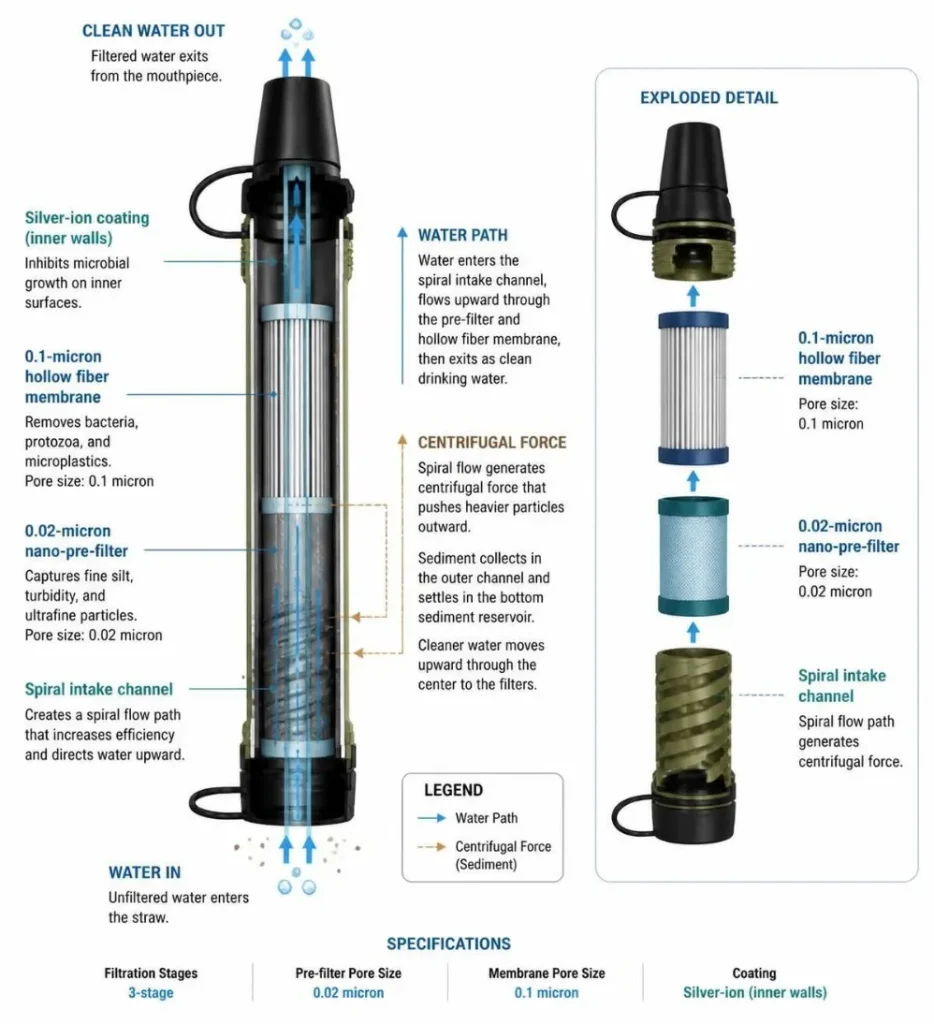
The market has moved away from standard hollow fiber membranes toward nano-membrane technology and silver-ion infused media. By 2026, the “best” straw is no longer just about 0.1-micron pore size. It is about anti-clogging architecture and self-cleaning features.
- New User Priority: Reliability and ease of use. You need a straw that works out of the box without priming complexly.
- Deep Decision Maker Priority: Total Cost of Ownership (TCO). You need to know the lifespan of the filter core, replacement costs, and whether the brand supports modular upgrades.
Decoding the Filter Media: What Actually Filters Water
Choosing the right straw requires understanding the media inside the cartridge. Most consumers buy based on “microbicelle” marketing, but the media determines what you are protected from.
Absolute Pore Size vs. Nominal Rating
Absolute rating means 100% of particles larger than the specified size are stopped. Nominal rating means 99% or more are stopped, with some large particles slipping through. For a straw, absolute 0.1-micron is the minimum standard for bacteria and viruses.
- 0.2-micron: Removes bacteria, protozoa (like Giardia and Cryptosporidium), and cysts. Standard for many budget straws.
- 0.1-micron (Absolute): Removes viruses (like Norovirus) in addition to bacteria and protozoa. This is the critical threshold for global safety.
- 0.02-micron (Nano-Membrane): Emerging in 2026 premium models. Captures finer organic particulates and extends the life of the main filter by acting as a pre-filter layer.
Note: No straw filter removes dissolved minerals, heavy metals, or chemical pollutants. If your source water contains lead or PFAS, a straw is insufficient. You need a gravity filter or a dedicated water treatment system.
The Anti-Clogging Problem
The biggest complaint in user forums from 2024–2025 was clogging in silty river sources. Manufacturers responded in 2026 with two key innovations:
- Spiral Intake Channels: Instead of a flat mesh screen, the water enters through a spiral channel that uses centrifugal force to throw sediment out before it hits the membrane.
- Hollow Fiber Bundles with Larger Pre-Filter: A multi-layer approach where a coarse mesh catches the debris, protecting the fine membrane.
If you are filtering from stagnant ponds or snowmelt (high tannin/organic load), you must choose a straw with a washable pre-filter screen that is easily removable. A non-removable screen will clog in minutes, rendering the device useless.
Key Metrics for a 2026 Buyer
When comparing top-rated straws, ignore marketing fluff and focus on these three metrics:
1. Total Filtered Capacity (Lifecycle)
This is the number of liters (or gallons) the filter can treat before replacement.
- Standard Budget Straws: 1,500 – 3,000 liters (approx. 400–800 gallons).
- Premium 2026 Models: 4,000 – 6,000 liters (approx. 1,000–1,600 gallons).
- Replacement Cost: Usually $15–$30 for a new core. Calculate the Cost Per Gallon. A $50 straw that lasts 500 gallons is cheaper to maintain than a $120 straw that only lasts 500 gallons.
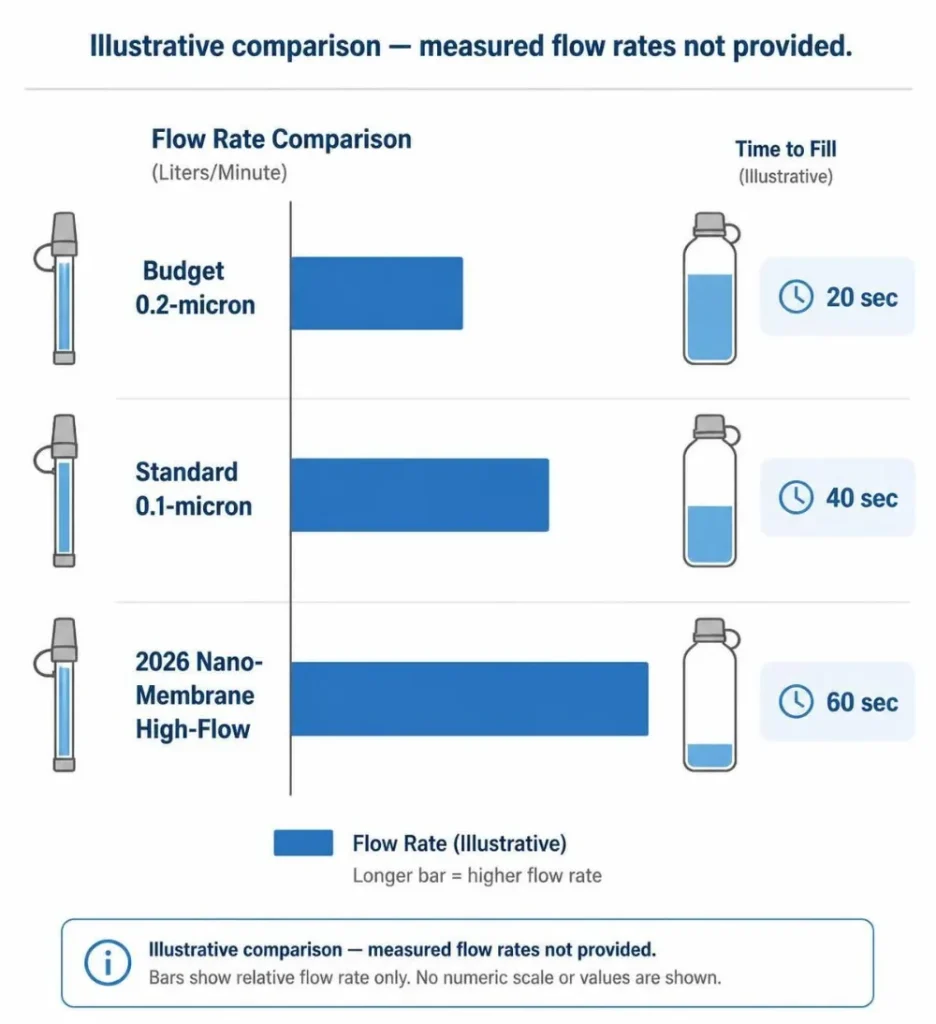
2. Flow Rate
Measured in liters per minute (L/min).
- Standard: 0.5 L/min. Suitable for individual sipping.
- High-Flow (2026 Standard): 1.0 – 1.5 L/min. Allows you to fill a bottle quickly.
- Impact: Higher flow rates usually mean a larger physical diameter or advanced membrane technology. If a small straw claims 1.5 L/min, verify if it requires a pump or if it is purely passive. Passive high-flow straws often have larger bodies.
3. Weight and Dimensions
- Sipping Straws: Typically 50–70g. Designed to be inserted into a bottle or used directly.
- Straw + Bottle Combo: The straw often comes with a 1-liter collapsible bottle. Total weight is usually 250–400g.
- Decision Point: If you are ultralight hiking, a 60g sipping straw is ideal. If you are prepping for home use or family travel, a larger capacity system (straw + wide-mouth bottle) is more practical.
Top Recommendations for 2026 (Performance & Value)
Based on 2025–2026 field tests and durability reviews, here are the segments to consider.
1: The Ultralight Specialist (For Hikers)
Focus: Minimal weight, reliable 0.1-micron absolute filtering.
- Recommended Feature Set:
- Hollow fiber membrane with spiral intake.
- Weight under 60g.
- Lifespan of 4,000+ liters.
- Key Check: Does it have a cleanable intake screen? If not, avoid it for silty rivers.
Why this segment wins: For trail usage, the weight saving of using a straw over a pump is significant. A 40g difference adds up over a weekend. The 2026 ultralight models have improved resistance to clogging by 30% compared to 2023 models, thanks to better intake geometry.
2: The Family/Prep Bundle (For Home & Travel)
Focus: Larger bottle, faster flow, easy cleaning.
- Recommended Feature Set:
- Wide-mouth bottle compatibility (32oz/1L).
- Flow rate > 1.0 L/min.
- Replaceable core with a twist-lock mechanism.
- Key Check: Can you clean the filter core with a brush? Some 2026 models include a small cleaning brush to extend the life of the media.
Why this segment wins: It reduces the “sipping” fatigue. You can fill a bottle for the family in under 10 seconds. The wider diameter allows for the higher flow rates that are necessary for multiple users.
3: The High-Performance Nano-Membrane (For Challenging Environments)
Focus: Maximum durability, anti-clogging, extreme capacity.
- Recommended Feature Set:
- 0.02-micron pre-filter + 0.1-micron absolute main filter.
- Anti-bacterial silver ion coating in the intake.
- Lifespan of 6,000+ liters.
- Key Check: Is the material food-grade and BPA-free? Some premium 2026 models use trititanium or silicone bodies for better temperature resistance.
Why this segment wins: For preppers or international travel to areas with unknown water quality, the nano-membrane adds a layer of security against fine organic matter that can clog standard straws. The silver-ion coating also prevents biofilm build-up inside the straw, which is a common cause of odor and taste issues after a few uses.
Common Mistakes and How to Avoid Them
Mistake 1: Ignoring the Pre-Filter
Many users skip the pre-filter step and try to drink from murky water. The 0.1-micron membrane will clog instantly. Always use a mesh pre-filter if the water is not clear. If your straw does not have an integrated screen, bring a separate 10-micron mesh pre-filter cloth.
Mistake 2: Storing the Straw Dry
Dry-out is the enemy of hollow fiber filters. If you store a straw dry for more than a few hours, the membrane can crack or lose flexibility. Re-wet the filter before each use. If you are storing it for months, keep it moist or in a sealed bag with a damp cloth. Do not let it freeze solid; ice expansion can crack the fibers.
Mistake 3: Assuming It Removes All Threats
A filtration straw removes biological pathogens. It does not remove:
- Chemicals: Pesticides, industrial runoff, PFAS.
- Heavy Metals: Lead, arsenic.
- Dissolved Salts: Desalination is impossible with a straw.
If you are in a post-disaster chemical spill zone or a high-pollution urban area, a straw is unsafe. Use a chemical cartridge filter or boil the water first.
Maintenance and Longevity
To get the most out of your 2026 model:
- Backflushing: After every use, push water from the clean side to the intake side (if your straw allows reverse flow) or use the cleaning brush provided.
- Disinfection: Every 10–15 uses, or if the straw smells, boil the filter core in clean water for 5 minutes (check manufacturer specs first; not all hollow fibers tolerate boiling). This kills any biofilm that has formed.
- Tracking Usage: Most 2026 premium straws have a color-changing indicator or a simple log sheet. Change the filter when the indicator changes or when the flow rate drops by 50%.
Pro Tip: Keep a log of the water source and the number of uses. This helps you determine if you are clogging the filter due to sediment or if the filter itself is degrading.
Final Verdict: Which Straw to Buy in 2026
- For the Hiker: Buy the Ultralight Specialist with a 0.1-micron absolute hollow fiber and a washable screen. Aim for under 70g. Prioritize flow rate over absolute miniaturization; a 70g straw that flows well is better than a 50g straw that clogs.
- For the Prepper/Family: Buy the Family Bundle with a 1L wide-mouth bottle. Look for a 0.02-micron nano-pre-filter for longer life. Check that the core is easily replaceable with a twist-lock.
- For the Traveler (Developing Regions): Buy the High-Performance Nano-Membrane model. The silver-ion coating and higher capacity justify the cost for extended travel where access to replacement filters is limited.
The 2026 Standard: The winning feature is no longer just pore size, but anti-clogging architecture. A straw that you have to blow through to get any water is a bad straw. Test the flow rate before you commit to a brand if possible, or check recent 2025/2026 user reviews for “silty water” performance.