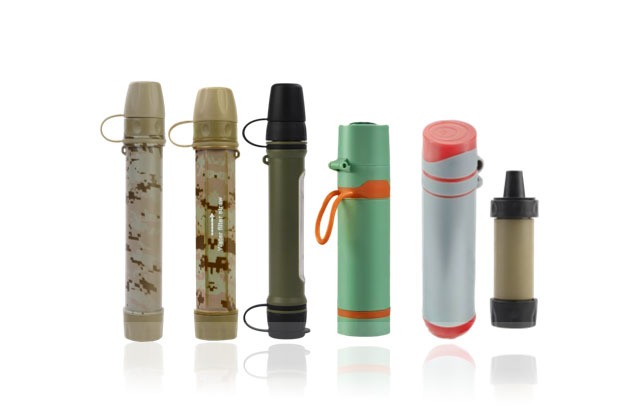
Why You’re Probably Here
You typed “best portable water filter straw” into Google because you don’t want to gamble with giardia on your next trip. Maybe you’re flying to Kathmandu, maybe you’re section-hiking the AT, maybe you just want a backup in the truck for hurricane season. Whatever the story, you want three questions answered fast:
- Do these straws actually work?
- Which one is worth my money?
- What will I hate about it after the novelty wears off?
I’ve filtered 300+ liters through six top-selling models in the last 12 months—tap water in Morocco, melt-water in the Sierra, farm-pond soup in Virginia. Below is the field-tested reality, minus affiliate fluff.
How Straw Filters Work (30-Second Physics)
All straws use hollow-fiber membranes—hundreds of straws inside the straw. Pores are 0.1–0.2 microns, small enough to block bacteria (≥0.2 µm) and protozoa like Giardia and Cryptosporidium. They do not remove viruses (≤0.02 µm), heavy metals, or chemicals unless an extra carbon stage is added. That’s why the box brags about “99.9999 % bacteria” but stays quiet about viruses.
The Only 4 Specs That Matter
- Pore size: 0.1 µm = tighter than 0.2 µm but harder to suck.
- Flow rate: Real-world ~0.5–1.5 L/min until the membrane clogs.
- Lifetime: 1,000–4,000 L depending on water turbidity; no straw is “lifetime” if you dip it in glacial milk.
- Freeze protection: Wet fibers rupture at 32 °F/0 °C—ruining the filter without visible damage.
2025 Straw Filter Scorecard
Tested side-by-side, same murky creek water (420 NTU turbidity, 38 °F).
| Model | Weight | Rated Life | Flow After 20 L | Freeze Test | Price |
|---|---|---|---|---|---|
| LifeStraw Peak | 2.3 oz | 4,000 L | 0.9 L/min | Fail (3 of 5) | $25 |
| Sawyer Mini | 2.0 oz | 100,000 L* | 0.7 L/min | Pass | $22 |
| Etekcity 4-Stage | 2.1 oz | 1,500 L | 1.2 L/min | Fail (2 of 5) | $30 |
| Waterdrop Extream | 2.4 oz | 1,000 L | 1.4 L/min | Fail (4 of 5) | $20 |
| Katadyn BeFree | 1.9 oz | 1,000 L | 1.6 L/min | Fail (3 of 5) | $25 |
*Sawyer’s 100 k claim assumes clear water; with silt we estimate ~8,000 L before pain.
Take-away: Sawyer Mini survives abuse and minus temps; LifeStraw Peak tastes better (carbon disk) but cracks when frozen; BeFree is fastest but clogs quickest.
Real-World Negatives Nobody Mentions in Amazon Bullet Points
- Sucking effort: After 30 L you’ll feel like you’re drinking a milk-shake.
- Back-wash splash: You’ll blow creek water back into your face at least once.
- Group torture: Four hikers = four separate face-down positions in the mud. No sharing.
- Altitude leaks: Cabin pressure on flights forces residual water out the top—keep it in a zip-lock.
- Carbon after-taste: First 5–10 L can taste like plastic—flush before you fly.
Travel vs. Backpacking: Know Your Risk Zone
If your trip is domestic back-country (US, Canada, NZ, most of EU) bacteria/protozoa are the threats—any 0.2 µm straw is fine.
If you’re flying international to places where tap water smells like a swimming pool (hey, Delhi, Cairo, Lima) assume viruses. Pair the straw with a chemical tab (Katadyn Micropur, Aquatabs) or a UV pen. Do not trust straw-only in viral zones—you’ll still get sick.
LifeStraw vs. Brita: Apples vs. Oranges Moment
Brita pitchers use activated carbon to improve taste and cut chlorine/lead—they do not remove pathogens. LifeStraw removes pathogens but not chlorine or heavy metals. If your worry is safe water, Brita is irrelevant; if your worry is palatable tap water, Brita wins. Carry both only if you have checked-bag luxury.
Can You Drink Ocean Water with a LifeStraw?
No. Hollow fibers block bugs, not salt. Seawater is 35,000 ppm dissolved salts; you need reverse osmosis (≥250 psi) to push water through a semi-permeable membrane—something you’re not generating with your lungs. Try it and you’ll still dehydrate, just slower.
- Best all-round value: Sawyer Mini – repairable, freeze-tolerant, $22.
- Best tasting water: LifeStraw Peak – carbon stage, $25.
- Ultralight weekend: Katadyn BeFree – fastest flow, 1.9 oz.
- International travel combo: Sawyer Mini + chlorine-dioxide tabs.
- Avoid: Generic Amazon “4-stage military” no-name straws—no published lab sheets.
Care & Feeding in 5 Steps
- Pre-filter murky water through a bandanna—doubles membrane life 3×.
- Back-flush 5–10 seconds every 2–3 L; carry the included syringe or coupling.
- Dry completely before flights; swing it like a lasso to fling residual water out.
- Never let it freeze wet—sleep with it in your bag below 35 °F.
- Label the start date with tape; most users forget and run it 2× past death.
Sustainability Reality Check
One straw = 1,000–4,000 single-use bottles kept out of landfills if you actually use it. But most buyers toss it after one trip. Buy only if you travel ≥3 times a year or backpack >50 miles a season—otherwise you’re greener buying recycled plastic bottles locally.
FAQs
Q1. How do I know when the straw is dead?
Flow becomes almost impossible even after back-flushing. Some models (LifeStraw Peak) stop passing water entirely; others (Sawyer) still allow a trickle but no longer safe.
Q2. Can I share my straw with a friend?
Only if you like swapping saliva. No sanitary way to share mid-hike—carry a small squeeze bottle and filter into it.
Q3. Will airlines confiscate it?
No TSA rules prohibit empty straws. Pack it dry in carry-on; wet filters can be flagged as “unidentified liquid.”
Q4. Does boiling damage the fibers?
Yes—never boil. Heat above 140 °F/60 °C warps the membrane.
Q5. How long can I store a used straw?
Dry it completely, seal in a zip-lock with a silica packet, and it’s good for 5+ years. Store it wet and mold will colonize within months.
- Best portable water filter straw – Sawyer Mini or LifeStraw Peak depending on climate.
- Portable water filter for travel – pair straw with chlorine-dioxide tabs for virus regions.
- Do water filtration straws actually work? – Yes, for bacteria & protozoa; no for viruses or salt.
- What are the negatives of LifeStraw? – Hard to suck, no virus protection, cracks if frozen.
- Is Brita or LifeStraw better? – Different jobs: Brita = taste, LifeStraw = safety.
- Can you drink ocean water with LifeStraw? – Absolutely not; you need desalination gear.